





STORY: UN / AI PEACE AND SECURITY PRESSER
TRT: 3:52
SOURCE: UNIFEED
RESTRICTIONS: NONE
LANGUAGE: ENGLISH / NATS
DATELINE: 20 OCTOBER 2026, NEW YORK CITY / FILE
1. Wide shot, exterior, United Nations Headquarters
20 OCTOBER 2026, NEW YORK CITY
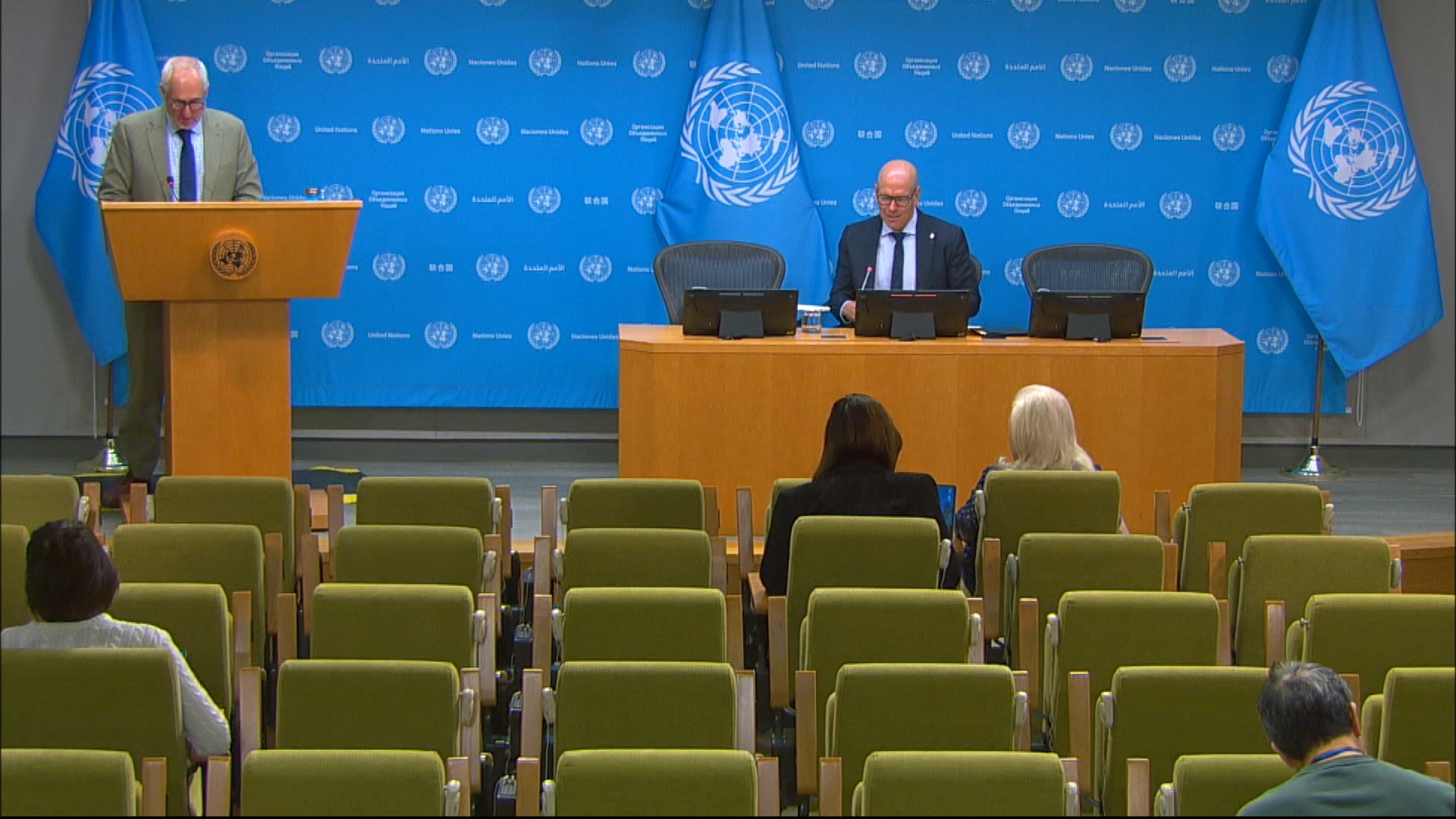
2. Wide shot, press briefing room
3. SOUNDBITE (English) Robin Geiss, Director of the United Nations Institute for Disarmament Research (UNIDIR):
“And let’s make mistake, Artificial intelligence autonomy are already embedded widely across the military domain. We find them in intelligence analysis and target identification, drones, cyber attacks, information operations, and so on as we speak. Decision cycles are compressing, the compressing to machine speed, and the margin for human judgment is increasingly narrow, including in the nuclear domain. Opaque systems are increasing the risk of error of miscalculation and escalation, unintended escalation, and the proliferation of AI capabilities means that the threshold, the entry point for very sophisticated operations, is getting lower, potentially also allowing non-state actors to engage in sophisticated operations supported by AI.”
4. Wide shot, press briefing room
5. SOUNDBITE (English) Robin Geiss, Director of the United Nations Institute for Disarmament Research (UNIDIR):
“A small number of countries and companies are shaping security outcomes in the domain of AI, in ways that traditional arms control frameworks were not designed to address, and in ways that profoundly affect the security of all other states on the planet.”
6. Wide shot, press briefing room
7. SOUNDBITE (English) Robin Geiss, Director of the United Nations Institute for Disarmament Research (UNIDIR):
“Now to be clear, geopolitical competition and tension are serious obstacles to the way forward, of course, but concerns about AI’s impact are already transcending geopolitical blocs and the prompting action from major powers. Just last month, for example, we saw the United States propose an AI safety hotline with China in case of an AI incident that could threaten national security. And the Secretary-General’s repeated calls for stronger regulation of military AI and legally binding treaty on lethal autonomous weapon systems increasingly find an echo across the international community.”
8. Wide shot, press briefing room
9. SOUNDBITE (English) Robin Geiss, Director of the United Nations Institute for Disarmament Research (UNIDIR):
“UNIDIR is developing a framework of responsible industry behavior that will provide practical, voluntary guidelines grounded in international law and in the UN Guiding Principles on Business and Human Rights. This will serve to establish a common baseline for responsible conduct across the technology lifecycle, which will go on to inform government procurement and public private partnerships. The targeted consultations are launching this week engaged the full spectrum of industry stakeholders, major and emerging defense technology companies, software developers, tool use service providers, subcontractors and investors all working alongside governments, civil society, academia and expert communities.”
10. Wide shot, press briefing room
11. SOUNDBITE (English) Robin Geiss, Director of the United Nations Institute for Disarmament Research (UNIDIR):
We find that States frequently use terms like
“We find that States frequently use terms like autonomy, safety, or security to mean very different things. And this ambiguity then leaks into national positions and approaches, and it gets into the way of finding agreement or building trust on the international level. This in mind, UNIDIR this Friday will launch a project to develop an AI security lexicon that will both clarify key concepts and also set out divergent understanding understandings that remain to date.”
12. Wide shot, press briefing room
13. SOUNDBITE (English) Robin Geiss, Director of the United Nations Institute for Disarmament Research (UNIDIR):
“Existing nonproliferation regimes, expert networks, export control frameworks, they provide a foundation for dealing with such issues. But the challenge of AI clearly extends far beyond the traditional scope of these instruments. Our aim is to identify where gaps remain and to come up, ideally with concrete measures that can be implemented at the national and international levels, while ensuring that efforts to prevent misuse do not limit access to the peaceful uses and benefits of artificial intelligence for all.”
14. Wide shot, press briefing room
The United Nations Institute for Disarmament Research (UNIDIR) will launch its Centre of Excellence on AI, Peace and Security Forum which presents the only multi-stakeholder body within the United Nations system that works on AI and international peace and security, and in the military domain.
The Director of UNIDIR Robin Geiss spoke to reporters today(20 Oct) ahead of the Thursday launch.
He said, let’s make mistake, Artificial intelligence autonomy
He said, “let’s make mistake, Artificial intelligence autonomy are already embedded widely across the military domain. We find them in intelligence analysis and target identification, drones, cyber attacks, information operations, and so on as we speak.”
Geiss continued, “decision cycles are compressing, the compressing to machine speed, and the margin for human judgment is increasingly narrow, including in the nuclear domain.”
He also highlighted that opaque systems are increasing the risk of error of miscalculation, unintended escalation, adding, “the proliferation of AI capabilities means that the threshold, the entry point for very sophisticated operations, is getting lower, potentially also allowing non-state actors to engage in sophisticated operations supported by AI.”
The Director UNIDIR pointed out that a small
The Director UNIDIR pointed out that a small number of countries and companies are shaping security outcomes in the domain of AI, “in ways that traditional arms control frameworks were not designed to address, and in ways that profoundly affect the security of all other states on the planet.”
Geiss said, “geopolitical competition and tension are serious obstacles to the way forward, of course, but concerns about AI’s impact are already transcending geopolitical blocs and the prompting action from major powers.”
He mentioned that just last month, the United States proposed an AI safety hotline with China in case of an AI incident that could threaten national security.
Geiss also noted that the Secretary-General’s repeated calls
Geiss also noted that the Secretary-General’s repeated calls for “stronger regulation of military AI and legally binding treaty on lethal autonomous weapon systems increasingly find an echo across the international community.”
He also informed reporters that during the course of next week, three other centre initiatives will be unveiled.
The first addresses the role of industry and aims at developing a framework for responsible industry behavior.
He said, UNIDIR is developing a framework
He said, “UNIDIR is developing a framework of responsible industry behavior that will provide practical, voluntary guidelines grounded in international law and in the UN Guiding Principles on Business and Human Rights,” explaining that it will serve to establish a common baseline for responsible conduct across the technology lifecycle, “which will go on to inform government procurement and public private partnerships.”
Geiss continued, “the targeted consultations are launching this week engaged the full spectrum of industry stakeholders, major and emerging defense technology companies, software developers, tool use service providers, subcontractors and investors all working alongside governments, civil society, academia and expert communities.”
The second key initiative will address the issue of language. The UNIDIR Director explained, “We find that States frequently use terms like autonomy, safety, or security to mean very different things. And this ambiguity then leaks into national positions and approaches, and it gets into the way of finding agreement or building trust on the international level. This in mind, UNIDIR this Friday will launch a project to develop an AI security lexicon that will both clarify key concepts and also set out divergent understanding understandings that remain to date.”
The third initiative will address the risk
The third initiative will address the risk of misuse of I and AI capabilities by non-state up non-state armed groups.
Geiss explained, “Existing nonproliferation regimes, expert networks, export control frameworks, they provide a foundation for dealing with such issues. But the challenge of AI clearly extends far beyond the traditional scope of these instruments. Our aim is to identify where gaps remain and to come up, ideally with concrete measures that can be implemented at the national and international levels, while ensuring that efforts to prevent misuse do not limit access to the peaceful uses and benefits of artificial intelligence for all.”
In June 2026, UNIDIR launched its Centre of Excellence in response to the rapid transformation that artificial intelligence is bringing to the global peace and security landscape. The Centre is a permanent platform to consolidate knowledge, connect stakeholders, and sustain momentum between high-level summits and multilateral processes.
Designed to ensure continuity and coherence across processes
Designed to ensure continuity and coherence across processes and initiatives, foster inclusive global engagement, and provide practical and evidence-based policy guidance, re efforts to govern AI in peace and security contexts are at a critical juncture
The Forum is an inclusive, multistakeholder platform for engagement, exchange, and collaboration. By formalizing participation at the organizational level, it is designed to provide a dedicated, neutral space for an exchange of perspectives, the collection of inputs through consultations, and support dissemination and collaboration across the wider ecosystem.


1 Comment
Pingback: Central team visits Cuddalore - The Daily Republic